Enterprise security can no longer be assessed only at the point of login. Once users enter the workspace, they move across private applications, virtual desktops, SaaS platforms, web resources and sensitive business data. In many organisations, these interactions are governed by separate tools, agents and policy models.
That separation creates the real risk. Access may be controlled, but web activity, SaaS usage and data movement may still be enforced through disconnected layers. For IT and security leaders, the result is inconsistent visibility, duplicated endpoint administration, fragmented policy enforcement and higher effort.
The Accops and Forcepoint integration addresses this gap by bringing secure workspace access and data-first web security into a connected operating model.
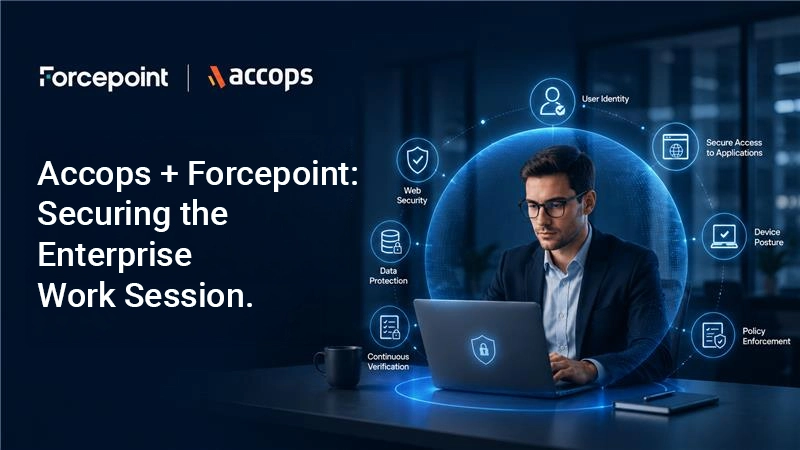
Accops governs identity, private application access and virtual workspace delivery. Forcepoint extends protection across internet access, SaaS activity and sensitive data movement. Together, the platforms help organisations protect the complete work session.
Why this matters
Most enterprises have invested in access security, web security, SaaS governance and data protection. The issue is not the absence of controls. It is the distance between them.
In a typical work session, a user may authenticate through one system, access a private application through a ZTNA layer, browse through a proxy, use SaaS applications governed by separate policies and move sensitive data through monitored workflows. When these controls do not operate in context with each other, policy consistency becomes difficult to sustain.
This is especially relevant when users connect from offices, branches, home networks, customer sites and unmanaged locations. Security can no longer depend on where the user is sitting or which network they are on. It needs to follow the user, device, application and data throughout the session.
For CIOs, CISOs and infrastructure leaders, the question is whether the organisation can apply consistent control across private access, internet usage, SaaS interaction and sensitive data movement without adding complexity or user friction.
Understanding the integration
The Accops and Forcepoint integration brings together two complementary layers of enterprise security. Accops provides the secure workspace and private access foundation, covering identity-led access, HySecure ZTNA, virtual applications and desktops, secure enterprise browsing and centralised workspace policy control.
This allows organisations to govern how users authenticate, enter the workspace and access private enterprise resources without opening broad network-level access.
Forcepoint extends that control into the web, SaaS and data layer. Secure Web Gateway capabilities help govern internet access, CASB provides visibility and control over SaaS usage, DLP helps identify and prevent sensitive data leakage, and DSPM helps organisations understand where sensitive data resides and where exposure risks may exist.
The integration is not about placing two security stacks next to each other. It makes workspace access, private application access, internet security, SaaS governance and data protection work as part of the same enterprise session.
How the integration works
The integration applies controls based on user, device, destination and traffic type, while keeping the experience unified.
The user logs into the Accops Workspace Client, where HySecure evaluates identity, device posture and applicable access policies. Based on the configured policy, the Forcepoint agent can be downloaded, installed and activated.
Once the session begins, traffic follows the control path:
- Private application traffic is routed through Accops HySecure ZTNA for application-specific access.
- Virtual applications and desktops are delivered through the Accops secure digital workspace.
- Internet and SaaS traffic is routed through Forcepoint Secure Web Gateway controls.
- Sensitive data activity is governed through Forcepoint DLP and DSPM controls.
This allows secure private access and web, SaaS and data protection to operate simultaneously within the same workspace, without separate user journeys or manual endpoint workflows.
Core capabilities
-
Contextual access control
HySecure verifies identity, device health and access context before granting application access, so decisions are policy-led rather than location-led.
-
Zero Trust private access
Private applications are accessed through Accops ZTNA without broadly exposing the corporate network.
-
Virtual workspace security
Accops enables secure access to virtual applications and desktops across distributed users and devices.
-
Secure internet access
Forcepoint Secure Web Gateway helps monitor web traffic, filter malicious destinations and apply acceptable usage policies.
-
SaaS governance
Forcepoint CASB gives organisations visibility and control over SaaS usage, risky sharing and policy enforcement.
-
Data leakage prevention
Forcepoint DLP helps discover, classify and control sensitive data movement across endpoints, networks, web and SaaS environments.
-
Data security posture visibility
Forcepoint DSPM helps identify where sensitive data resides, who can access it and where exposure risks may require remediation.
-
Automated agent orchestration
The Forcepoint agent can be deployed based on HySecure policy, reducing manual endpoint configuration.
What this changes for enterprises
The integration shifts the control model from secure access alone to session-wide protection. Security teams can apply controls not only at login, but across private applications, virtual desktops, internet access, SaaS usage and sensitive data movement.
For IT teams, the value is operational simplification. Forcepoint agent deployment can be driven by HySecure policy, reducing manual endpoint configuration and avoiding fragmented access and web security workflows.
For compliance and risk teams, the architecture supports broader visibility across user activity and data interaction, which is relevant for regulated organisations that need stronger governance across access, web, SaaS and data channels.
For business and infrastructure leaders, the value is consolidation without weakening control. Accops brings the identity, secure workspace and private access layer. Forcepoint brings the web, SaaS and data security layer. Together, they help reduce fragmentation while protecting the complete enterprise work session.
The session becomes the control point. A user may access a private application, launch a virtual desktop, browse the internet, use SaaS platforms and interact with sensitive data within the same session. The integration governs these activities through a connected security model instead of treating them as separate problems.