For years, end-user computing followed a predictable model: run Windows desktops and applications on physical endpoints, then layer security and management controls on top. In a hybrid world, that model is fundamentally broken. The endpoint is now the most distributed part of the enterprise and often the least consistent, making it harder to enforce security, compliance, and operational discipline at scale.
The challenges with a PC-led end-user computing model
The illusion of a secure perimeter. Security posture is uneven by default. Even in well-managed environments, endpoints drift. Patch levels vary, configurations change, device health fluctuates, and users operate across networks and locations you do not fully control. This is exactly where latent risk accumulates, especially when sensitive applications and data are processed locally on devices that are inherently difficult to audit in real-time.
Operational cost keeps climbing. Physical endpoints demand constant attention: patching cycles, troubleshooting, remote support, imaging, compatibility fixes, policy exceptions, and tool maintenance. The real cost is not only software and hardware. It is also the persistent cognitive load on IT teams trying to keep the edge stable while the business expects speed, flexibility, and uptime.
Tooling helps, but the model creates limits. Most organisations already run DLP, SASE, and endpoint security platforms. DLP often depends on pattern matching and policy tuning, which is not mathematically assured in every scenario and can struggle against sophisticated exfiltration methods or insider behaviour. SASE can secure access pathways effectively, but it typically has zero visibility into endpoint-level data behaviour, especially on unmanaged devices.
Forced upgrades as a business risk. Modern operating systems evolve quickly, and organisations are frequently pushed into large-scale upgrades or migrations on fixed timelines. When an OS release reaches the end of vendor support, security patches stop arriving. For many enterprises, this creates an artificial crisis: either fund widespread device upgrades, accept higher exposure, or decouple the workspace from the underlying hardware.
Sustainability pressure is rising. Endpoint-heavy strategies also make it harder to show progress on green initiatives. Manufacturing and shipping contribute significantly to a device’s lifecycle footprint. When employee devices represent a meaningful portion of IT’s environmental impact, the EUC strategy becomes a liability for ESG reporting.
Enter VDI: Centralise the workspace, reduce reliance on endpoint trust
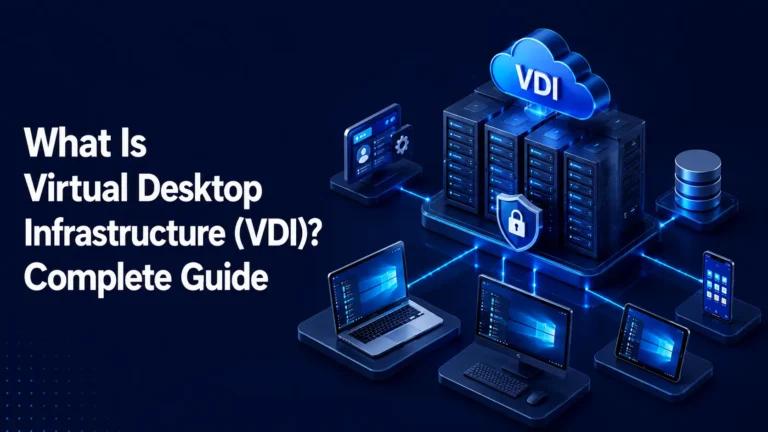
VDI changes where work happens. Instead of running the desktop OS and applications on the endpoint, the user’s desktop and apps run inside the data centre, and only a secure session is delivered to the device. That shift matters because it moves execution, data handling, and control into an environment that can be monitored, governed, and audited far more consistently than a distributed endpoint fleet.
As compliance expectations tighten and regulatory obligations increasingly demand demonstrable controls, this becomes a pragmatic way to strengthen governance without trying to perfect every endpoint.
What VDI delivers in practice
- Stronger security by design. When applications and data remain within the data centre, exposure from lost devices, unmanaged BYOD, and local malware is reduced materially. It also narrows the pathways through which data can be copied, stored, or exfiltrated, because the work stays central. It effectively air-gaps the corporate data from the local OS.
- Faster patching and controlled application risk. VDI allows centralised image management. Updates and patches can be applied and rolled out faster than coordinating thousands of physical machines over weeks. Critical or vulnerable applications remain protected inside a monitored infrastructure rather than scattered across endpoints.
- Lower operational friction and better agility. Centralised delivery reduces repetitive end-user support overhead and makes onboarding and change management faster. It also supports practical operating models such as BYOD for short-term projects, rapid provisioning for teams, and standardised environments for developers and testers without multiplying physical devices.
- Simpler compliance and audits. A centralised workspace model makes it easier to evidence controls. Access pathways, workspace policies, and user activity can be logged and reviewed more consistently. Data locality and governance requirements are also easier to meet when processing stays within controlled zones.
- A clearer path to greener endpoints. VDI pairs well with lower-power, longer-life endpoints, including thin clients. This supports energy efficiency at the edge and reduces e-waste by extending device lifecycles.
Where Accops fits
For CIOs and CISOs, the question is rarely “VDI or not.” It is whether the organisation can standardise secure workspaces quickly, remain audit-ready, and reduce endpoint exposure without building an expensive, fragmented stack.
Accops supports this through its Digital Workspace Solution Suite, bringing together application and desktop virtualisation with identity controls (SSO, MFA) and endpoint options such as thin clients. The intent is to simplify how workspaces are delivered and governed: centralise what matters, enforce consistent controls, and reduce operational overhead, aligned to the pillars of agility, flexibility, and affordability.
Conclusion
PC-to-VDI migration is increasingly driven by governance reality. As hybrid work expands, compliance becomes more critical, sustainability reporting becomes more visible, and recurring OS upgrade cycles force enterprise-wide decisions, VDI offers a practical reset: centralise execution, reduce data exposure, improve control consistency, and make audit outcomes easier to defend.
Done with the right scope, VDI is not a refresh project. It is a more resilient, agile, and compliant end-user computing operating model.