Introduction
Virtual desktops were once expected to deliver standard business applications from controlled enterprise environments. That expectation has changed.
Today’s users work across locations, networks, and devices, while relying heavily on HD video calls, browser-based applications, rich media, real-time collaboration, and graphics-intensive workloads. This has placed new pressure on traditional remoting protocols.
When the display protocol cannot keep pace, users experience latency, poor video playback, audio delays, inconsistent call quality, and sluggish desktop responsiveness. For IT teams, the impact can show up as higher bandwidth consumption, greater infrastructure load, reduced user density, and more complexity in scaling VDI or DaaS environments.
This is the context in which Accops has developed Photon, its next-generation display protocol for modern virtual desktop and DaaS environments.
Why This Matters
For enterprises, virtual desktop performance is no longer measured only by whether a desktop launches. The real measure is whether the experience is responsive enough for everyday work.
Users expect virtual desktops to support meetings, browsers, media, and real-time interaction with the same ease they expect from a local machine. If the experience is delayed or inconsistent, adoption suffers and users look for workarounds.
The challenge becomes sharper in hybrid work, where users may connect from home broadband, mobile networks, branch offices, customer locations, or unmanaged networks. Bandwidth, latency, and packet loss can vary widely.
Accops developed Photon to address the need for better video and audio synchronisation across different operating systems, endpoint environments, and network conditions.
By building this capability into its own display protocol architecture, Accops aims to deliver a more consistent multimedia experience for virtual desktop and DaaS users.
Understanding Photon
Photon is Accops’ high-performance, OS-agnostic display protocol built for virtual desktops and next-generation DaaS environments.
In simple terms, Photon is the remoting engine that delivers the virtual desktop experience from the data centre or cloud infrastructure to the user’s device. It is designed to make that experience more responsive, efficient, and suitable for modern workloads such as video conferencing, browser-intensive applications, multimedia playback, and graphical applications.
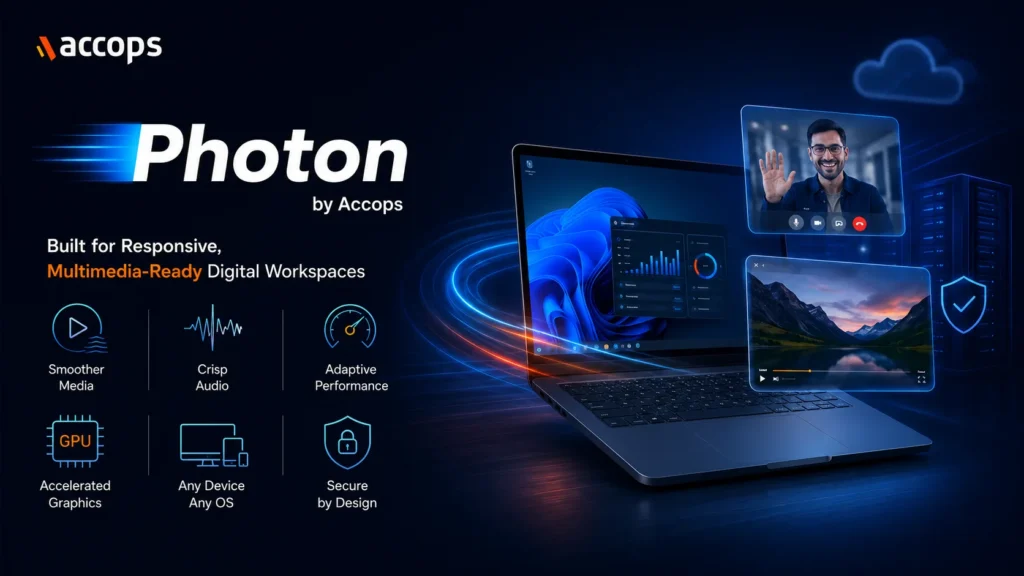
Photon combines adaptive display delivery, intelligent audio and video redirection, GPU acceleration, and real-time network adaptation. Instead of treating every workload the same way, it optimises how media, display updates, and user interactions are processed and delivered.
For example, when a user plays a video inside a virtual desktop, Photon can redirect media processing more efficiently to the endpoint device. This helps reduce server-side load and improve playback quality. During a live video call, microphone and audio redirection help maintain real-time communication without adding avoidable strain on the virtual desktop infrastructure.
The objective is to deliver a more local-like virtual desktop experience across operating systems, devices, and network conditions, while keeping enterprise control and security intact.
Core Capabilities
Intelligent Audio and Video Redirection
Redirects media processing where it can be handled more efficiently, helping improve playback, audio clarity, and real-time communication while reducing server-side load.
Audio-Video Synchronisation
Helps maintain better sync between voice, video, and user interaction during media playback and live communication inside virtual desktops.
Dynamic Network Adaptation
Adapts to changing bandwidth, latency, and packet loss to help maintain smoother sessions across different user environments.
GPU Acceleration and Advanced Encoding
Uses data centre GPU capabilities to improve rendering performance, reduce CPU utilisation, and support graphics-intensive or rich media workloads.
OS-Agnostic Remoting Engine
Supports consistent virtual desktop delivery across different operating systems, endpoints, and device types, including thin clients and mobile devices.
Secure by Design
Works within the Accops secure digital workspace architecture, so performance improvements remain aligned with identity, access control, and Zero Trust requirements.
What This Means for Enterprises
Photon helps make virtual desktops more suitable for how enterprises work today.
For users, it means smoother navigation, more consistent video playback, clearer audio, and more natural live communication. This is important because user experience directly influences VDI and DaaS adoption.
For IT teams, Photon can help reduce the infrastructure strain created by multimedia-heavy workloads. By optimising media handling and using GPU acceleration, enterprises can improve performance without depending only on additional server resources.
For infrastructure and EUC leaders, Photon provides greater flexibility in supporting different endpoint types and user environments, including laptops, thin clients, mobile devices, and mixed endpoint estates.
For security and compliance teams, the value lies in improving performance without weakening governance. Since Photon works within the Accops secure digital workspace architecture, enterprises can continue to apply identity, access, and security controls while improving the end-user experience.
In practical terms, Photon helps reduce the trade-off enterprises often face between performance, scale, and security.
Who Should Evaluate Photon
Photon is relevant for organisations that already use, or are evaluating, VDI and DaaS for a distributed workforce.
It should be particularly useful for enterprises supporting hybrid work at scale, organisations running browser-heavy or multimedia-rich applications, EUC teams looking to improve VDI performance, IT teams managing video conferencing inside virtual desktops, and businesses using thin clients, mobile devices, or mixed endpoint environments.
It is also relevant for organisations evaluating high-performance virtual graphical workstations or modernising their virtual desktop strategy as older remoting approaches become less suited to multimedia-first work.
Strategic Value
Photon strengthens Accops’ control over one of the most important layers of the digital workspace experience: how the virtual desktop is delivered to the user.
As enterprise work becomes more interactive, distributed, and media-rich, the display protocol becomes central to user experience, infrastructure efficiency, and workspace scalability.
By developing its own high-performance protocol, Accops can innovate more closely across VDI, DaaS, secure access, identity, endpoint experience, and Zero Trust workspace delivery.
To explore Photon in more detail, connect with the Accops team.