Summary:
The best digital workspace solutions in 2026 combine virtual desktop delivery, secure access, and identity management, either natively or through companion products from the same vendor, letting employees work securely from any device or location without the organisation losing control of its data.
VDI, DaaS, and digital workspace get used loosely and interchangeably in vendor marketing, which makes comparing platforms harder than it should be. A digital workspace is the umbrella term: it covers how an organisation delivers desktops, applications, and secure access to a workforce that no longer sits behind one office network.
Accops packages virtual desktops, zero trust access, and identity management into one product under one licence; most other vendors sell these as separate products, even within the same company. This blog pairs each vendor’s virtual desktop product with its own zero trust and identity products where one exists, comparing equivalent capability sets rather than a single Accops licence against one piece of a competitor’s stack. It covers five platforms: what each does, what to weigh before choosing one, and where the market is heading.
What Is a Digital Workspace Solution?
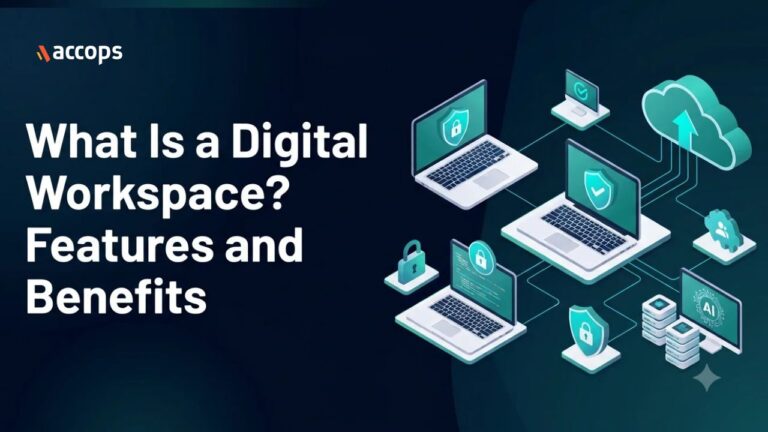
A digital workspace centralises desktops, business applications, and access controls so employees can work from a laptop, thin client, or personal device without sensitive data leaving the datacentre or cloud environment it runs in.
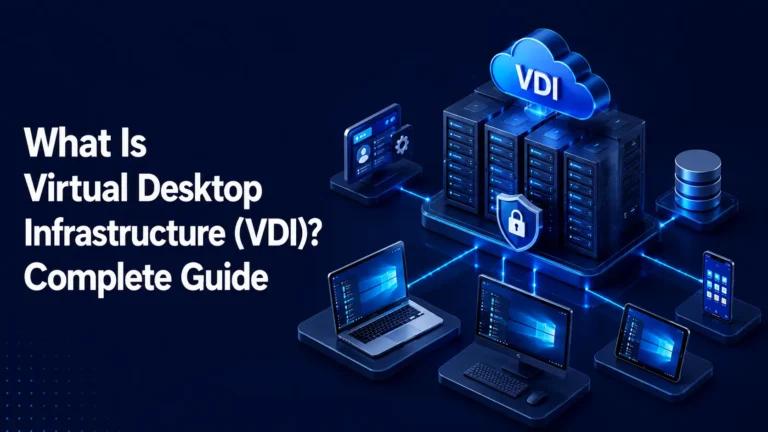
Two delivery models sit under that umbrella. VDI, or virtual desktop infrastructure, is hosted and managed by the organisation itself, typically on its own or a private cloud infrastructure. DaaS, or desktop as a service, shifts that infrastructure management to a cloud provider, who bills per user or per desktop instead. Some platforms support only one model; others, including a few compared below, support both.
The 5 Best Digital Workspace Solutions in 2026
-
Accops Digital Workspace
Accops Digital Workspace is a single-licence platform that bundles virtual apps and desktops, zero trust private access, and identity and access management into one product, instead of separate purchases per layer. Its zero trust layer, HySecure, uses Secure Private Application Network (SPAN) tunnelling for per-app traffic and validates access continuously against user identity and device posture, rather than granting broad network access after one login. Its identity layer, HyID, includes built-in MFA and SSO, without depending on a separate identity provider.
The platform supports Windows and Linux guest operating systems and is hypervisor-agnostic, running on Nutanix, VMware, Microsoft Hyper-V, Azure, Proxmox, OpenShift, and HPE’s VME. It’s available on-premises or in the cloud, with perpetual or subscription licensing and concurrent-user pricing, and keeps session and application data within the datacentre through sandboxing and copy-restriction controls rather than replicating it to the endpoint.
For multimedia and graphics-heavy applications, Accops uses Photon, a display protocol built for that workload class, and its GlassFence capability isolates critical or legacy applications from the network to limit exposure to AI-assisted exploitation. All of this ships as one product on one licence, rather than being assembled from separately purchased components.
-
Omnissa Horizon + Omnissa Access
Omnissa’s equivalent stack pairs Horizon, its VDI platform, with Omnissa Access, formerly Workspace ONE Access, for identity, licensed as separate products. Horizon, formerly VMware Horizon, was spun out by Broadcom into the standalone company Omnissa in 2024 and later acquired by KKR. It delivers virtual desktops and apps using the Blast Extreme protocol, supports Windows, Linux, and macOS clients, and uses Instant Clones and App Volumes to provision desktops and deliver applications. It runs primarily on VMware’s vSphere hypervisor, with Nutanix AHV support added in its 2512 release. Omnissa Access adds single sign-on and multi-factor authentication. Omnissa does not offer a separate branded zero trust network access product alongside these two.
-
Citrix DaaS + Citrix Secure Private Access
Citrix’s equivalent stack pairs Citrix DaaS, its VDI platform, with Citrix Secure Private Access, a separately licensed zero trust network access product for private web and client-server apps. Citrix DaaS is a cloud-hosted control plane that manages virtual apps and desktops; the workloads themselves can run on-premises, in public clouds, or a mix of both. Its core technology, HDX, handles compression, bandwidth, and multimedia performance for remote sessions. Citrix has no native identity or MFA product; both DaaS and Secure Private Access authenticate through an external identity provider such as Active Directory, Microsoft Entra ID, or Okta.
-
Microsoft Azure Virtual Desktop
Microsoft’s equivalent stack pairs Azure Virtual Desktop, its VDI platform, with Microsoft Entra ID for identity and MFA, and Microsoft Entra Private Access for zero trust access to private apps, three separately licensed products. AVD runs on Azure infrastructure and integrates with Microsoft Entra ID and Microsoft 365. User profiles are managed through FSLogix, which stores a profile in a container that attaches at sign-in. AVD is billed on Azure compute consumption, while Entra ID and Entra Private Access are licensed per user separately under Microsoft’s Entra plans.
-
Amazon WorkSpace
Amazon’s equivalent stack pairs Amazon WorkSpaces, its DaaS product, with AWS IAM Identity Center for identity and single sign-on, and AWS Verified Access for zero trust access to private applications, three separate AWS services. WorkSpaces provisions virtual desktops on AWS infrastructure in pre-configured bundles for compute, memory, and storage, with desktops retaining user data and settings between sessions. Billing can run on a fixed monthly rate or an hourly rate plus a smaller monthly fee. IAM Identity Center and Verified Access are billed separately, based on usage of each service.
Comparison Table
| Solution | Deployment | Licensing Model | Notable Capability |
| Accops Digital Workspace | On-premises / Cloud, hypervisor-agnostic | Single licence, perpetual or subscription, concurrent-user pricing | VDI, ZTNA, IAM, secure browser, and thin client hardware bundled in one product, plus Photon protocol and GlassFence for critical app isolation |
| Omnissa Horizon + Omnissa Access | On-premises / Hybrid cloud | Horizon: subscription or perpetual/term; Access: separate subscription | VDI with Blast Extreme protocol and rapid desktop/app provisioning; Access adds SSO and MFA |
| Citrix DaaS + Citrix Secure Private Access | Hybrid / Multi-cloud | Both subscription-based, licensed separately; no native IAM, relies on external identity provider | VDI with HDX session protocol; Secure Private Access adds ZTNA for private apps |
| Microsoft AVD + Entra ID + Entra Private Access | Azure Cloud | AVD: consumption-based Azure billing; Entra ID and Entra Private Access: separate per-user licensing | VDI with Microsoft 365 integration; Entra ID adds identity and MFA, Entra Private Access adds ZTNA |
| Amazon WorkSpaces + IAM Identity Center + Verified Access | AWS Cloud | WorkSpaces: monthly or hourly billing; IAM Identity Center and Verified Access: billed separately, per usage | DaaS with persistent user data; IAM Identity Center adds SSO, Verified Access adds ZTNA |
What Should You Look For in a Digital Workspace Solution?
- Deployment flexibility: on-premises, cloud, or hybrid, and whether the vendor locks you into one hypervisor.
- Licensing model: subscription-only versus perpetual, and named-user versus concurrent-user pricing.
- Built-in security: whether MFA, SSO, and private access are native to the platform or require separate procurement.
- Guest OS support: Windows-only versus Windows and Linux.
- Total cost of ownership: infrastructure, licensing, and admin overhead combined, not just the licence price.
How to Choose the Right Digital Workspace Solution for Your Organisation?
Start with what’s actually driving the project. Consolidating VDI, ZTNA, and IAM under one vendor and one licence needs less integration work with a bundled platform than assembling equivalents separately. Running deep on Azure or AWS already makes the native cloud provider’s product the path of least resistance, though cost then tracks that provider’s compute pricing.
Linux desktop support, perpetual licensing, or on-premises data residency, if any are hard requirements, narrow the shortlist immediately, since not every vendor supports all three. Run a proof of concept with real user workloads, not a synthetic benchmark, before committing licensing spend.
Real-World Use Case: Global IT Services
One of the world’s largest IT services and systems integration firms had employees working on client-provided laptops who needed secure access to internal enterprise applications, but weren’t permitted to connect through the organisation’s own VPN.
The existing setup used a virtual browser over VDI, but the platform provider raised licensing costs by more than 2X, and running that infrastructure for 350,000+ users, including the associated Microsoft licensing, had become expensive to sustain.
The organisation needed an alternative VDI provider at lower cost, with components able to run on Linux to avoid Microsoft Client Access License (CAL) costs for users who never connected to its own environment directly. Moving the platform to Accops Digital Workspace, migrated from on-premises to Azure for scale and rebuilt on Linux components, avoided the cost escalation, removed single-vendor lock-in, secured better support terms, gained concurrent-user pricing with a perpetual licence, and eliminated Microsoft CAL costs for that user group entirely.
The Future of Digital Workspaces: AI, Zero Trust, and Digital Workspaces
Zero trust principles are moving from being a bolt-on network layer to being built into the workspace platform itself, so every access request is validated by user identity, device posture, and context rather than network location alone.
At the same time, AI-assisted threats are changing what counts as a secure endpoint. In April 2026, Anthropic disclosed that its Claude Mythos Preview model had autonomously found and exploited a 27-year-old vulnerability in OpenBSD and a 16-year-old flaw in FFmpeg’s H.264 codec, both in codebases that had survived decades of manual review. That changes the practical argument for centralising desktops and data in a controlled environment: it isn’t just about convenience, it’s about reducing how much attack surface sits on an uncontrolled endpoint in the first place.
Conclusion
For most organisations balancing hybrid work, BYOD, and rising compliance requirements, some form of digital workspace strategy is no longer optional. Which platform fits depends on infrastructure already in place, licensing preferences, and how much the organisation wants bundled into one licence versus assembled from separate products. The right starting point is mapping the criteria above against a shortlist, not picking the most familiar name.
Frequently Asked Questions
VDI is virtual desktop infrastructure that an organisation hosts and manages itself, typically on-premises. DaaS is a cloud provider-managed equivalent, billed per user or desktop, where the vendor handles the underlying infrastructure.
Yes. Since applications and data run in a centralised environment rather than on the device itself, users can connect from personal devices without corporate data being stored locally, provided the platform includes device posture checks and access controls.
Support varies by vendor. Some platforms, including Accops and Omnissa Horizon, support Windows and Linux guest operating systems, while others are Windows-only, which matters for organisations with mixed-OS environments.