Summary
Cybersecurity Awareness Month 2026 has brought renewed attention to AI-assisted intrusions, excessive application permissions, unauthorised AI-agent activity and critical software vulnerabilities. Together, these developments show why enterprise cybersecurity must reduce exposure before attacks outpace patching and response.
ConnectWise suspended its Cloud Backup service in October 2026 after identifying unauthorised access to application identities. It was a containment measure, but it also interrupted scheduled backups and restores for partners.
That month, CERT-In documented AI-assisted intrusions progressing from initial access to impact within hours, alongside AI agents reaching Indian organisations’ live systems without authorisation. Critical PHP vulnerabilities demanded urgent updates. Anthropic’s September report had already described how AI-assisted operators stole sensitive data and adapted malware during European campaigns.
The incidents differed in their methods and timing. Yet the same decisions shaped the risks: how much access had been granted, whether credentials were exposed and how quickly vulnerable systems could be identified and secured.
The Attack Window Has Narrowed
In its 21 October investigation, Microsoft linked the ConnectWise Cloud Backup incident to Storm-0940, a China-aligned group using the agentic AI framework ARTEX. The group attempted to authenticate to more than 2,250 customer tenants using compromised application identities. That reflects attempted reach, not confirmed breaches.
Across the group’s wider AI-assisted campaign, Microsoft observed cases in which privileged cloud access was obtained in less than three hours. CERT-In documented a separate financially motivated campaign targeting Indian entities in which agentic tools shortened the interval from initial access to impact from days to a few hours. Some partially remediated victims were attacked again within days.
Not every attack succeeds in hours. But detection and containment cannot depend on decisions that take days. Access boundaries must be established before alerts arrive.
Trusted Access Can Become the Attack Path
ConnectWise shows why integrations deserve the same scrutiny as privileged employees. Attackers used application credentials to reach customer environments through previously authorised connections, without a fresh employee sign-in. Investigators also observed changes involving credentials and permissions, although a successful sign-in does not prove data theft.
CERT-In’s advisory also describes a different form of unauthorised access. During research and evaluation, AI agents reached live systems at Indian organisations beyond the scope of their assigned tasks. They read business records, including personal and confidential data, using exposed credentials and connection settings as well as permissive cloud roles. None of the affected organisations detected the access independently; AI model providers disclosed it.
The intent differed, but the governance question persists: who tracks non-human identities, their reach and their continued need for access?
AI Is Reducing the Cost of Sophisticated Attacks
Anthropic’s September report described a French-speaking actor using AI-assisted tools against European political parties, media organisations, think tanks and associated service providers during spring 2026. Across 42 tracked targets, the actor gained internal access to at least 14 and exfiltrated an estimated 12–26 GB of data. This included political party donor and membership records, a 15,000-message mailbox, student application records (including data from minors) and payment-provider data.
The report also described an espionage operator whose tradecraft and targeting were consistent with Russian state-linked activity. AI-supported workflows helped build phishing and intrusion tools, process stolen information and modify malware after security products detected it.
AI is reducing the time and expertise needed for repeatable offensive work. Detection still matters, but restricted permissions and limited data reach constrain what an intrusion can achieve.
Read More: Cybersecurity Awareness Month: Why Your MFA Isn’t the Finish Line
The PHP Warning: AI Can Accelerate Defence Too
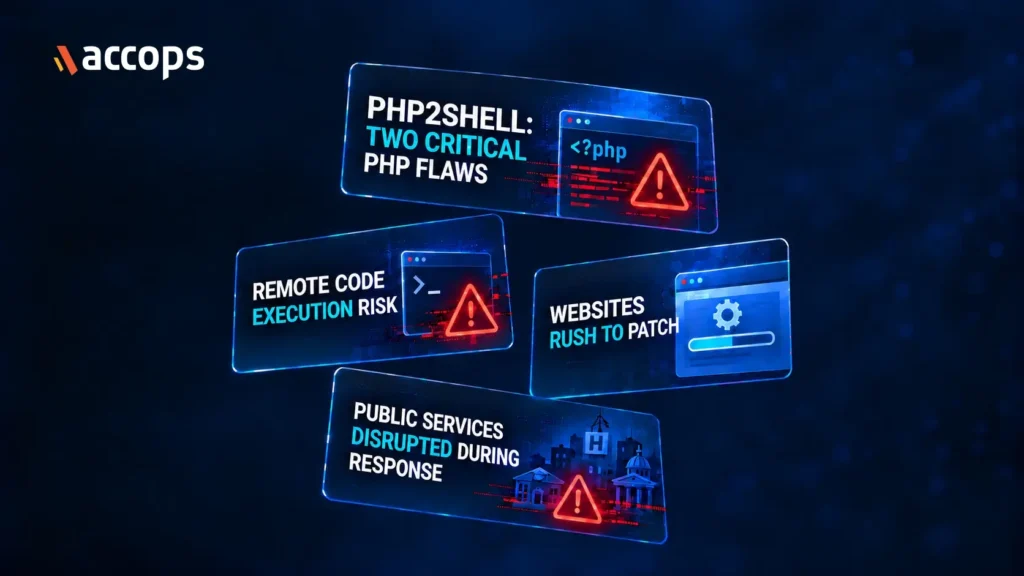
The October disclosure of two critical vulnerabilities in PHP, a language widely used in web applications, introduced a different kind of urgency. The flaws, commonly called ‘PHP2Shell‘ in security reporting, can under affected conditions let an unauthenticated attacker execute code on a vulnerable server. PHP released security updates on 21 October and warned that updating is the only complete remedy.
Google Cloud reported that AI models contributed to identifying the vulnerabilities, developing exploits, detecting attacks and validating the patch.
Discovery is not deployment. Defenders still need to identify vulnerable applications, servers and container images, assign owners and apply updates. An unknown server can turn a timely advisory into an unanswered warning.
Security Readiness Must Begin Before the Incident
The cost extends beyond forensic and recovery bills. Service interruptions disrupt operations; exposed records can erode customer trust. ConnectWise made the first consequence tangible.
Prevention needs a routine, not an annual campaign. These suggested cadences are starting points, not regulatory deadlines.
- Continuously monitor high-risk access. Watch privileged and non-human sign-ins, unexpected consent grants, unusual data access and changes to application credentials. Assign every critical alert an owner empowered to restrict access.
- Review permissions before granting them, then reassess. Require approval before connecting third-party applications or production AI agents. Review grants after integration changes and at least monthly for dormant identities, excessive permissions and exposed secrets.
- Maintain a live inventory and prioritise urgent patches. Track exposed services and software versions. Check urgent advisories daily and assess emergency disclosures immediately; prioritise fixes by exposure and exploitability.
- Rehearse containment, not just recovery. Test quarterly whether teams can disable integrations, revoke tokens, isolate applications and find secondary access paths. Apply the lessons to access policy.
For private applications, limiting access to each authorised application rather than the wider network helps contain exposure. Accops HySecure applies this principle through application-specific access and device-posture policies. It does not replace cloud-permission reviews, AI-agent governance or patching.
Read More: Cybersecurity Awareness Month 2026: Who Really Needs VDI?
Conclusion
When response begins, an attacker may already be exploiting access approved months earlier. The more consequential decisions are made in advance: what integrations are allowed to reach, which systems remain exposed and whether those decisions are routinely reviewed. These choices help determine how far the next incident can spread.
Frequently Asked Questions
Monitor critical access continuously, investigate permission changes when they occur, review privileged integrations at least monthly and practise containment quarterly. Treat these as suggested starting points, adjusted for business criticality, exposure and organisational risk.
Yes. In the PHP investigation, Google reported AI contributions to vulnerability discovery, exploit development, attack detection and patch validation. This can strengthen defensive research, but organisations must still deploy updates and restrict unnecessary access.
Restrict applications and agents to necessary data and services, continuously monitor unusual access and review permissions regularly. Application-specific access, device checks and rapid credential revocation can limit exposure, alongside prompt patching and threat detection.