Summary
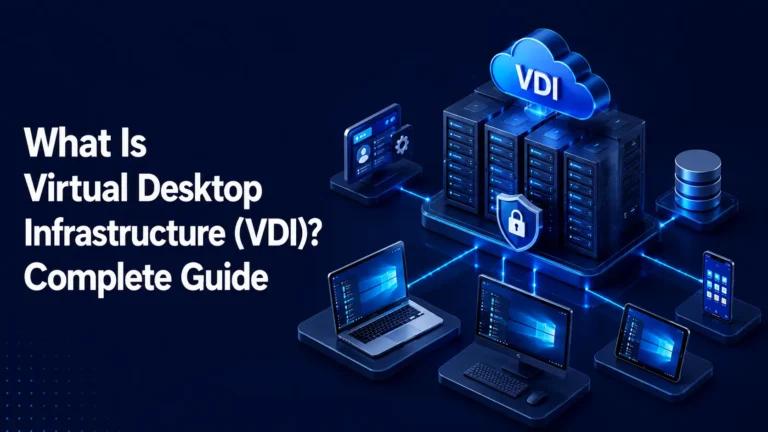
Enterprise data security and workforce mobility require a transition from fragmented point solutions to a unified digital workspace environment. This structural architecture consolidates access control, application delivery, and identity governance into a single, observable plane. By decoupling application delivery, user profiles, and access management layers from specific underlying hypervisors and local endpoints, modern digital workspace frameworks reduce total cost of ownership while insulating IT budgets from shifting vendor licensing models.
Introduction
The traditional concept of the corporate office has permanently shifted. Modern enterprise success is no longer tied to a physical desk, but to how seamlessly your teams can connect, collaborate, and execute from anywhere in the world. However, as hybrid models solidify, IT leaders face unprecedented friction balancing user productivity with stringent compliance requirements.
According to global research by McKinsey, knowledge workers spend roughly 20% of their workweek simply searching for and gathering information due to fragmented systems. To bridge this gap, forward-thinking organisations are moving away from costly and complex point solutions. Instead, they are consolidating operations into a unified digital workspace.
Implementing a strategic framework allows enterprises to mitigate execution drag, eliminate shadow IT risks, and deliver an optimised digital experience that drives measurable business growth.
What Is a Digital Workspace?
Rather than functioning as a standard remote-access portal, a unified digital workspace acts as a fully software-defined layer that decouples application delivery and user states from the underlying physical hardware. It abstracts the desktop and application layer entirely, presenting a standardised operational surface to the worker.
For the end-user, it can implement deployment options such as a secure single sign-on (SSO) gateway to consolidate access across modern web apps, SaaS tools, and internal client-server systems, representing one configuration method within a broader application security layout.
For the IT department, it establishes a single point of data governance. By operating at the application and session layer rather than exposing the entire corporate network perimeter, it provides an elegant way to maintain operational agility while enforcing a strict security posture across a highly distributed workforce.
What Are the Benefits of a Digital Workspace?
Transitioning to a centralised digital workspace architecture offers significant strategic advantages for enterprise leaders looking to optimise operational expenditure and boost workforce performance:
-
Enhanced Data Security and Compliance:
By centralising application delivery and data processing within a secure data centre or cloud environment, no sensitive corporate information leaves the enterprise perimeter. Features like advanced clipboard control, screen-recording prevention, and dynamic watermarking protect data even on unmanaged consumer devices.
-
Reduced Total Cost of Ownership (TCO):
Juggling multiple distinct vendors for virtual desktop infrastructure (VDI), Multi Factor Authentication (MFA), and secure access gateways introduces ballooning licensing costs and immense support overhead. A unified platform consolidates these capabilities, significantly reducing capital and operational expenses.
-
Optimised Employee Experience:
Eliminating context-switching across a dozen fragmented interfaces reduces digital fatigue. Workers gain immediate, responsive access to the exact resources they need, leading to a more engaged and agile workforce.
-
Agile Operational Scaling:
Whether onboarding third-party vendors, integrating newly acquired business units during corporate mergers, or scaling remote operations rapidly, a software-defined workspace allows IT administrators to provision secure user profiles within hours rather than weeks.
What Are Two Key Features of the Digital Workspace?
While a modern digital workspace includes an array of microservices, two foundational pillars dictate its enterprise-grade security and daily usability:
-
Zero Trust Network Access (ZTNA):
Traditional VPNs often grant broad network-level access, exposing the corporate core to lateral threat movement. A secure digital workspace utilises ZTNA to enforce access control strictly at the application layer. Identity is verified continuously, ensuring that users only see and interact with the specific applications authorised for their specific role.
-
Contextual Access Control and Integrated Identity Management:
Security must adapt to user environment dynamics. Contextual access engines evaluate real-time parameters, such as the user’s geographical location, login time, and current endpoint device health (anti-virus status, OS patch updates), before granting entry. Paired with integrated Multi-Factor Authentication (MFA), it creates an adaptive security perimeter that responds to risk dynamically.
What Is Unified Digital Workspace Management?
Unified management merges separate infrastructure tools into a single observable system, governing the entire lifecycle of end-user computing through automation. It spans capacity planning, user profile management, session recording, and automated environment orchestration.
True enterprise-grade management provides deep visibility into how applications perform and how infrastructure is utilised. This enables IT administrators to spot performance bottlenecks proactively before they affect end-user productivity.
Furthermore, it incorporates automated profile management tools (such as FSLogix integration) to ensure user configurations and personal settings remain consistent, responsive, and familiar, regardless of which physical thin client or personal laptop they use to log in.
Strategic Industry Insights: The Fragmentation Cost
To understand the true value of a unified framework, enterprise leaders must evaluate the real-world operational penalties of fragmented systems.
According to a recent Gartner report, organisations equipped with a formal digital workplace strategy achieve their business transformation goals at twice the rate (62%) compared to those operating without a defined plan (31%).
Conversely, the risk of unmanaged tool sprawl is escalating. Industry research from Deloitte emphasizes that human-centred, experience-led digital transformation strategies succeed only when technologies operate in synchrony, connecting the workforce experience directly to clear business outcomes. Fragmentation creates massive visibility gaps, amplifies vulnerability surfaces, and strains internal helpdesk teams.
How Organisations Can Future-Proof Digital Workspaces
To protect technology investments from market volatility, IT decision-makers must design architectures prioritising decoupled infrastructure and hardware independence. Industry consolidation, exemplified by sweeping changes in enterprise virtualization licensing structures, has shown how single-vendor lock-in can instantly expose budgets to soaring operational costs.
True future-proofing demands a highly modular infrastructure strategy. Enterprise digital workspaces should act as an abstract, flexible orchestration layer that operates smoothly above any hypervisor background, whether running on legacy on-premises infrastructure, Nutanix, or native cloud hyperscalers like Azure and AWS.
By ensuring the workspace delivery software remains entirely decoupled from the underlying compute layer, organisations can migrate active workloads, pivot cloud strategies, and adopt next-generation application delivery models without forcing a costly redesign of the entire employee end-user computing experience.
How to Organise Your Digital Workspace
A highly functional environment requires structured layout principles to ensure administrative clarity and ease of use:
-
Consolidate Entry Points:
Eliminate the chaos of multiple URLs. Direct all users to a single, unified web portal where virtual amps, SaaS platforms, and remote desktops coexist under a single sign-on experience.
-
Implement Role-Based Access Tiers:
Structure user permissions logically by department and operational risk. A finance executive, a third-party developer, and a frontline support agent should each see a strictly curated catalogue of applications tailored to their exact daily mandates.
-
Enforce Strict Endpoint Compliance:
Organise your digital workspace layout around zero trust. Set up automated scanning routines that verify endpoint health prior to launching a session, keeping non-compliant devices isolated in a secure sandbox environment.
The Accops Solution: Empowering the Modern Enterprise
For organisations seeking to escape the trap of complex, multi-vendor point products, the Accops Digital Workspace delivers a fully integrated, enterprise-ready answer. Accops seamlessly unifies application and desktop virtualisation (VDI), ZTNA-based secure access gateways, and robust Identity & Access Management (IAM) into a single, high-performance platform.
The Accops product ecosystem provides everything required to run a high-security virtual operation:
-
Accops VDI:
Drives high-density application and desktop virtualisation, allowing smooth delivery of corporate workspaces to any device.
-
Accops HySecure:
Functions as the ZTNA-based application access gateway, keeping the internal network hidden while delivering secure last-mile connectivity.
-
Accops HyID & BioAuth:
Delivers contextual access control alongside advanced Multi-Factor Authentication, including biometric validation for high-security environments.
-
Accops HyDesk & Nano:
Offers hardened, energy-efficient endpoints and secure container operating systems on bootable USB drives, completely isolating corporate data from personal malware risks on BYOD hardware.
By eliminating vendor friction, Accops drastically reduces total cost of ownership while delivering session security and a frictionless user experience.
Conclusion
Investing in a robust digital workspace strategy is no longer a tactical IT checkbox; it is a core business imperative that dictates enterprise agility, data resilience, and employee retention. Juggling multiple disparate, costly tools only compounds administrative complexity and exposes the enterprise to unnecessary compliance risks.
By partnering with Accops, organisations can deploy a fully managed, hypervisor-agnostic environment that satisfies both the C-suite’s budget goals and the CISO’s rigorous security standards. Prepare your infrastructure for tomorrow’s operational demands. Explore how the Accops Digital Workspace Solutions can transform your enterprise workspace strategy today.