Desktop as a Service has moved well past its pandemic-era reputation as a stopgap for remote work. Gartner’s 2025 Magic Quadrant for Desktop as a Service forecasts DaaS spending to grow from 4.3 billion USD in 2025 to 6.0 billion USD by 2029, a compound annual growth rate of 7.9 percent.
The same research points to cost optimisation and sustainability, not just remote access, as the newer drivers of adoption. Total cost of ownership for DaaS, particularly when paired with thin clients, is now reported to be lower than a laptop PC for many use cases, and Gartner expects virtual desktops to be financially viable for 95 percent of the workforce by 2027, up from 40 percent in 2019.
With more vendors competing for the same budget line, choosing a provider now means weighing deployment model, licensing predictability, and security architecture against each other, not just picking the most familiar name.
What to Look for in a DaaS Provider
Before comparing vendors, it helps to be clear on what actually separates a strong DaaS offering from an average one.
- Deployment model: fully managed cloud-only service versus hybrid options that let you keep desktop resource capacity on your own infrastructure
- Licensing model: subscription, consumption-based, or a mix, and how predictable the cost is at scale
- Identity and access integration: built-in MFA and zero-trust access controls versus dependency on an external identity provider
- Protocol and OS support: how the remote display protocol handles graphics-heavy or high-latency workloads, and whether the service goes beyond Windows
Top 5 Desktop as a Service (DaaS) Providers
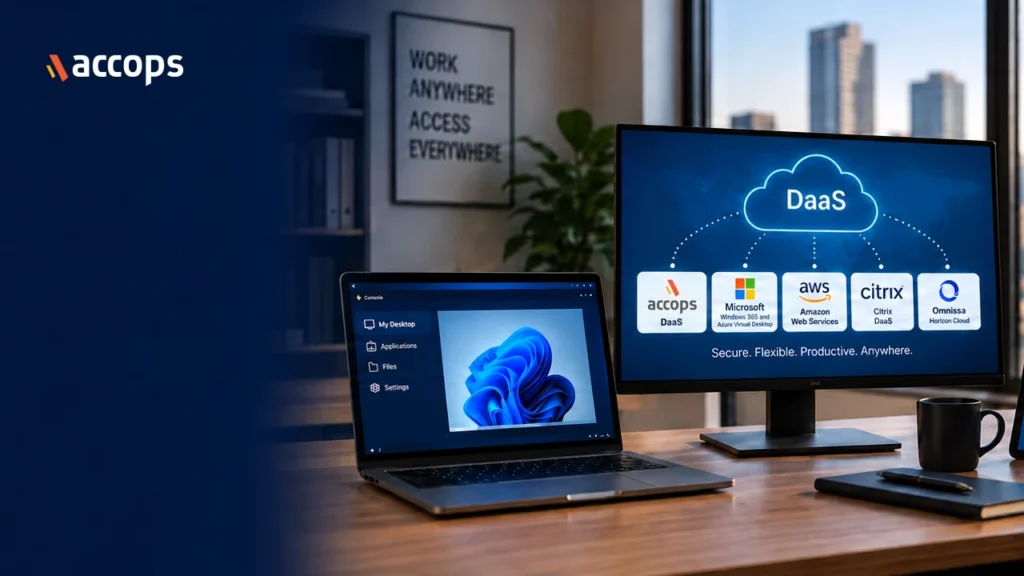
Accops DaaS is a fully managed, cloud-hosted virtual desktop service on Microsoft Azure, provisioning pooled and personal desktops across Windows, Windows Server, and Linux on a pay-as-you-consume subscription. It includes native Azure integration such as FSLogix profile containers and Microsoft Teams optimisation.
Access control is built in: zero-trust checks based on device posture, geolocation, and time; endpoint controls that restrict peripherals, screen sharing, and data copy; and multi-factor authentication across SMS, email, mobile app, and biometric verification. Intelligent power management scales virtual machines and applies idle timeouts, and Accops manages thin client hardware from the same console.
Accops offers DaaS through three routes, Accops Managed Desktops, JioPC for Enterprise, and Accops for AVD, and was named in Gartner’s 2025 and 2026 Magic Quadrant for Desktop as a Service. Separately, it sells Digital Workspace for organisations that want to run virtual desktop infrastructure themselves, on-premise or across their own hypervisors and cloud accounts, rather than consume it as a hosted service; Accops DaaS itself is cloud-hosted only, like the other entries on this list.
-
Microsoft (Windows 365 and Azure Virtual Desktop)
Gartner named Microsoft a Leader in its 2025 Magic Quadrant for DaaS through three products: Azure Virtual Desktop, Windows 365, and Microsoft Dev Box.
Windows 365 provisions a dedicated Cloud PC per user, a persistent Windows machine billed at a flat monthly rate regardless of usage. Windows 365 Business supports up to 300 users per tenant and has no licensing prerequisites, while Windows 365 Enterprise has no seat limit and is managed through Microsoft Intune, with Microsoft Entra ID and Defender for Endpoint available as part of the wider Microsoft 365 stack.
Azure Virtual Desktop is the more configurable option, billed on Azure resource consumption and supporting multi-session Windows, published applications, and non-persistent desktop pools. Gartner notes that this flexibility makes AVD more complex to configure than Windows 365, and that organisations often bring in third-party tools to manage it at scale.
Both products integrate with the wider Microsoft 365 and Azure ecosystem, which is the main consideration for organisations already standardised on those platforms.
-
Amazon Web Services (AmazonWorkSpaces)
AWS is also a 2025 Gartner Leader, offering DaaS through Amazon WorkSpaces and AppStream. WorkSpaces Personal, the persistent desktop option, is the primary product AWS offers to new customers today, using the Amazon DCV display protocol, with dedicated storage retained between sessions. Beyond Windows, it supports Linux distributions including Red Hat Enterprise Linux, Rocky Linux, Amazon Linux, and Ubuntu.
Two older parts of the lineup are being wound down: AWS stopped offering the PCoIP protocol and the non-persistent WorkSpaces Pools option to new customers in 2026, with existing customers able to continue on both through 2027. For non-persistent, shared-desktop use cases, AWS now directs new customers to a separate product, Amazon WorkSpaces Applications.
WorkSpaces is billed on either flat monthly pricing or hourly metering, and it integrates with Microsoft Entra ID and Intune for identity and device management.
-
Citrix DaaS
Citrix is a longstanding Leader in Gartner’s Magic Quadrant for DaaS. Citrix DaaS manages on-premises data centre and public cloud workloads together in a hybrid deployment: administrators can connect to on-premises hypervisors, including XenServer, Microsoft Hyper-V, Nutanix AHV, and VMware vSphere, as well as public cloud capacity on Azure, AWS, or Google Cloud, all managed from a single Citrix Cloud control plane.
The service uses Citrix’s HDX protocol for the remote desktop connection and includes policy controls for managing access across those different resource locations. Pricing is subscription-based and varies by user count, feature tier, and deployment option.
-
Omnissa(Horizon Cloud)
Omnissa is the standalone company formed when Broadcom divested VMware’s end-user computing division to KKR, a transition completed in 2024. Its Horizon Cloud service is the direct continuation of the VMware Horizon product line, and Gartner has named it a Leader in the DaaS Magic Quadrant for three consecutive years.
Horizon Cloud is built around what Omnissa calls Thin Edge Infrastructure, a lightweight on-premises footprint paired with a cloud-hosted control plane that centrally handles connection brokering, image management, and monitoring. It supports several resource providers, including Microsoft Azure, Amazon WorkSpaces Core, on-premises VMware vSphere, and OpenStack.
A newer Horizon Cloud on Microsoft Azure Standard Subscription option targets customers who do not need the full feature set of the flagship service. Omnissa’s customer base is largely existing VMware Horizon 8 users migrating to a cloud-managed model without giving up their on-premises investment.
| Provider | Pricing Model | Notable Feature |
| Accops DaaS | Pay-as-you-consume subscription | Zero-trust access & MFA built in; manages thin clients |
| Microsoft (Windows 365 / AVD) | Flat monthly or Azure consumption | Only one with a dedicated cloud workstation for developers (Dev Box) |
| AWS (Amazon WorkSpaces) | Hourly or flat monthly | Only one billed hourly as well as monthly |
| Citrix DaaS | Subscription | Connects four on-premises hypervisor types from one control plane |
| Omnissa (Horizon Cloud) | Subscription | Direct continuation of the original VMware Horizon product line |
Which DaaS Provider Fits Your Organisation
There is no universal best answer among these five, and the right pick maps back to the criteria already covered above. Organisations that want a fully managed, cloud-hosted desktop service without owning infrastructure, but still need zero-trust access and identity built in, are a natural fit for a provider like Accops DaaS.
Organisations already committed to one hyperscaler generally default to that platform’s native offering, Windows 365 or Azure Virtual Desktop for Microsoft-centric estates, WorkSpaces for AWS-centric ones. Large, multi-hypervisor enterprises with strict compliance or data residency requirements, including a need to keep some resource capacity on-premises, tend to look at Citrix or Omnissa.
Conclusion: Which DaaS Provider Is Right for 2026?
Every provider on this list solves the same problem, delivering a secure, centrally managed desktop, but each does it with a different set of trade-offs around deployment, pricing, and ecosystem lock-in. Hyperscaler-native options like Windows 365 and WorkSpaces suit organisations already standardised on that cloud.
Citrix and Omnissa fit large, hybrid, multi-hypervisor estates with complex compliance demands and a need to keep some capacity on-premises. Providers such as Accops fill a different gap: a fully managed cloud service that bundles VDI, zero-trust access, and identity together for organisations that would rather not assemble that stack from multiple vendors.
Before shortlisting a DaaS provider, map your existing identity and hypervisor investments, your data residency obligations, and your appetite for consumption-based versus predictable billing. That exercise, will point to the right fit for your organisation in 2026.
Frequently Asked Questions
DaaS is a cloud-delivery model where a provider hosts virtual desktops and streams them to end-user devices over the internet. The provider manages the underlying infrastructure, while the organisation manages user access, applications, and policies on top.
Traditional VDI is typically self-hosted and self-managed on an organisation's own hardware. DaaS shifts infrastructure management, patching, and scaling to a third-party provider, billed as a subscription or consumption-based service instead of a capital purchase.
Yes. Most DaaS providers, support access from unmanaged personal devices, typically through a client application, HTML5 browser access, or a secure container that isolates corporate data from the personal device.