Summary
Evaluating a viable VMware alternative is a critical board-level mandate for enterprise infrastructure strategies facing complex subscription updates. Choosing the right VMware alternative requires balancing hypervisor independence against public cloud lock-in and variable consumption costs. While cloud-exclusive options restrict hybrid agility and traditional frameworks incur multi-tier security add-on costs, consolidated native platforms eliminate integration friction. Key architectural evaluation factors include removing multi-vendor software bloat, securing absolute budget predictability, and enforcing unified zero-trust controls across hybrid environments.
Evaluating Top VMware Alternatives
A detailed analysis of these digital workspace platforms highlights the architectural differences, structural layers, and fiscal models that enterprise technology leaders must assess when moving away from the traditional Omnissa Horizon baseline.
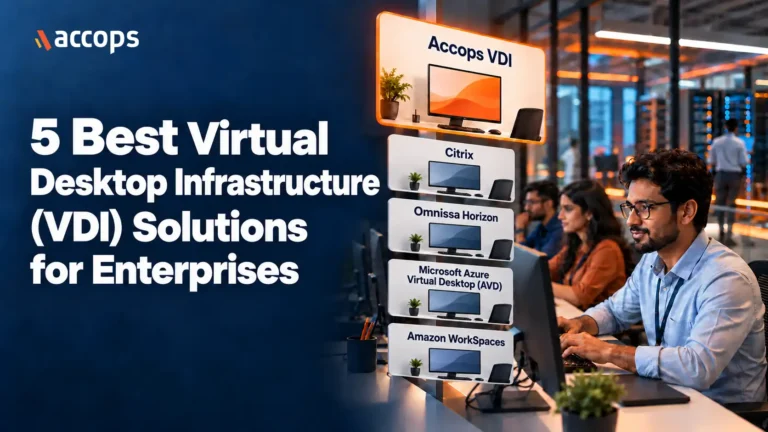
1. Accops Digital Workspace
-
Overview:
Accops Digital Workspace is a consolidated computing architecture integrating virtual desktop infrastructure, multi-factor authentication, Identity and Access Management, and single sign-on natively within a single software layer. The platform operates as a completely hypervisor-agnostic VMware alternative, executing seamlessly on Nutanix AHV, Microsoft Hyper-V, and open-source Proxmox VE environments.
-
Key Features:
Built-in zero-trust network access gateways, integrated secure access layers, native session analytics, automated compliance reporting, and advanced user productivity metrics for granular administration.
-
Business Impact:
Establishes commercial predictability by unifying disparate software layers into a single access framework. Eliminating multi-vendor stacks minimises ongoing contract overhead and renewal complexities. This ensures a stable, long-term VMware alternative without enforcing hypervisor lock-in.
-
Best For:
Large enterprises seeking to eliminate multi-vendor contract friction and deploy unified zero-trust workspace controls across heterogeneous environments.
2. Citrix DaaS
-
Overview:
A desktop and application virtualisation platform supporting hybrid corporate deployments across traditional data centres and public cloud networks. This framework functions as an alternative to VMware for enterprise teams requiring multi-cloud flexibility, though it requires specific component integrations to achieve a complete zero-trust profile.
-
Key Features:
HDX multimedia delivery protocols, adaptive authentication modules, session recording compliance tools, and granular administrative policy configuration consoles.
-
Business Impact:
High ongoing operational expenditures impact long-term financial predictability. Technology leaders encounter complex multi-vendor dependencies when implementing a comprehensive zero-trust model, requiring meticulous cost-benefit evaluation when shortlisting VMware alternatives.
-
Best For:
Infrastructures with large operational budgets willing to tolerate multi-tiered subscription pricing and multi-vendor security add-ons
3. Microsoft Azure Virtual Desktop
-
Overview:
A cloud-centric desktop virtualisation service built natively on specific public cloud infrastructure. It integrates tightly with existing enterprise identity directories and cloud-based business productivity suites.
-
Key Features:
Windows multi-session operating capabilities, FSLogix profile containers, automated cloud-based user profile management solutions, and native directory authentication.
-
Business Impact:
The framework imposes rigid public cloud dependencies. This architectural lock-in restricts choices for organisations with strict data residency rules, acting as an option for pure-cloud strategies rather than a hybrid VMware alternative.
-
Best For:
Siloed public cloud deployments that operate exclusively within a single vendor cloud ecosystem without on-premises delivery needs.
4. Amazon WorkSpaces
-
Overview:
A fully managed cloud desktop service operating within a single public cloud environment. The system functions on a consumption-driven billing framework that scales resources based on active compute hours.
-
Key Features:
Persistent cloud storage volumes, WorkSpaces Streaming Protocol, automated software patching mechanisms, and basic cloud directory integrations.
-
Business Impact:
Variable monthly billing introduces financial unpredictability for large-scale budgeting. The lack of native on-premises infrastructure compatibility limits long-term architectural agility. Organisations looking for an adaptable solution must factor in persistent outbound data transfer fees.
-
Best For:
Basic cloud desktop delivery where unpredictable usage fees and variable monthly consumption costs are acceptable to procurement.
Analytical Comparison Matrix of Digital Workspace
| Platform | Deployment | Strategic Summary |
| Accops Digital Workspace | Hybrid / Multi-cloud | Native consolidated VDI, identity, and MFA stack; avoids hypervisor lock-in. |
| Omnissa Horizon | Hybrid / Multi-cloud | Incumbent baseline; requires separate updated subscription contract renewals. |
| Citrix DaaS | Hybrid / Multi-cloud | Granular configuration control; incurs multi-tier licensing and security add-on costs. |
| Microsoft AVD | Azure Exclusive | Cloud-native multi-session delivery; creates rigid public cloud infrastructure lock-in. |
| Amazon WorkSpaces | AWS Exclusive | Managed instances; relies on variable consumption-driven hourly utility billing. |
Strategic Selection Criteria for Corporate Infrastructure
Modernising corporate workspace infrastructure requires rigorous technical validation against strict enterprise compliance standards. C-suite leaders must focus on three non-negotiable architectural benchmarks when selecting a stable VMware alternative
-
Complete Hypervisor Independence:
The workspace platform must operate across multiple virtualisation layers, including open-source environments, to insulate the enterprise from unpredictable subscription licensing shifts.
-
Consolidation of Software Bloat:
Architectures must avoid complex multi-vendor dependencies. Selecting a platform that natively unifies delivery layers eliminates integration failures and minimises operational management costs.
-
Phased Coexistence Capabilities:
Migration frameworks must support parallel operation of existing environments and new systems without performance degradation, ensuring zero disruption during transitions
Operational risk increases when modernised infrastructures introduce deployment friction and support fragmentation. Implementing a platform without native security forces administrative teams to manage disparate vendor escalation paths, creating severe troubleshooting delays.
Conclusion
Evaluating enterprise-grade digital workspace solutions requires balancing long-term technical agility with strict financial governance. Real operational simplicity stems from consolidating critical digital workspace components while maintaining absolute hypervisor independence.
By enforcing robust zero-trust security parameters natively within a unified delivery architecture, organisations can effectively eliminate multi-vendor support friction, minimise corporate network exposure, and achieve predictable annual infrastructure spending.
To modernise your digital workspace framework smoothly, schedule a comprehensive architectural alignment consultation with the enterprise technology specialists at Accops today to protect your operational continuity.
Frequently Asked Questions
The divestiture of VMware's End-User Computing division into Omnissa has introduced contract restructuring, mandatory subscription transitions, and updated administrative requirements. Corporate technology teams are seeking alternative platforms to secure predictable cost trajectories and long-term delivery support.
Point solutions require complex integrations for access gateways, multi-factor authentication, and identity databases. A consolidated native stack eliminates multi-vendor operational friction, reduces contract administration overhead, and closes compliance auditing gaps for IT leaders.
Platforms like Azure Virtual Desktop or Amazon WorkSpaces mandate execution within specific public clouds. This architectural restriction poses data residency challenges for regulated industries and prevents deployment in localised, hybrid, or highly secure air-gapped data centres.