Summary
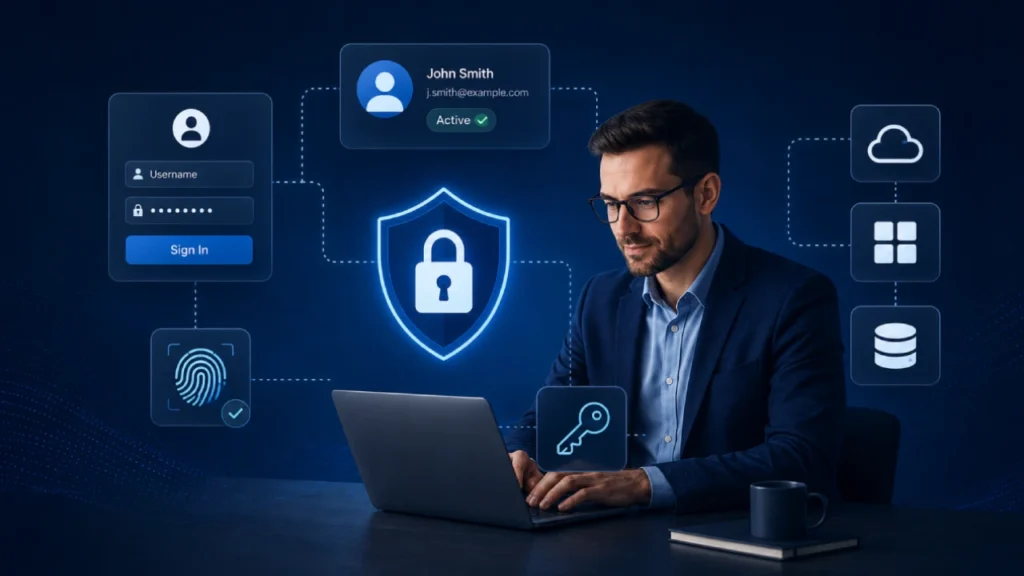
Identity and Access Management (IAM) is a cybersecurity framework that helps organisations securely manage user identities and control access to applications, systems, and data. It combines authentication, authorisation, SSO, MFA, and RBAC to enforce secure, least-privilege access. IAM strengthens protection against unauthorised access, supports regulatory compliance, and enables secure remote and hybrid work. It also plays a key role in modern Zero Trust security by continuously controlling and governing access based on identity and context.
What Is Identity and Access Management (IAM)?
In a modern digital enterprise, network perimeters no longer stop at the office door. As organisations adopt cloud infrastructure, software-as-a-service platforms, and distributed remote work models, traditional physical firewalls are no longer enough to secure critical data. In this modern ecosystem, identity has become the new security boundary.
Identity and Access Management (IAM) is a strategic cybersecurity framework consisting of policies, business processes, and integrated technologies that ensures authorised individuals access appropriate technology resources strictly for legitimate, business-justified reasons. By centralising digital identity governance, IAM transforms user credentials into dynamic policy checkpoints across the entire corporate network.
Why IAM Matters for Businesses?
The rapid transition to hybrid work environments and multi-cloud infrastructure has drastically expanded the cyber attack surface. Enterprise teams no longer operate within a single contained network. Instead, employees, third-party contractors, and automated software agents access corporate data from diverse locations and personal devices.
Without an integrated identity strategy, organisations face compounding security risks. Fragmented user credentials lead to weak password habits, privilege creep, and unmonitored access points that cyber attackers frequently exploit. Implementing a unified IAM framework mitigates these operational exposures, protects sensitive IP, and creates a scalable foundation for business growth.
How IAM Works?
At an operational level, IAM governs the complete lifecycle of a digital identity, from initial account creation to permanent offboarding. This lifecycle follows four continuous phases:
- Identification: The user asserts who they are by providing a unique identifier, such as an enterprise email address or employee registration number.
- Authentication: The IAM platform verifies the user’s identity through credentials, biometric scans, or security tokens.
- Authorisation: Once identity is confirmed, the policy engine checks configured access rules to determine which specific systems or files the user may open.
- Accounting and Auditing: The system maintains detailed logs of login attempts, privilege modifications, and file access, generating an immutable audit trail for governance.
Key Components of IAM
A modern IAM framework relies on four core technical components working together seamlessly:
- Centralised Identity Repositories: Directory services, such as Active Directory or LDAP, that serve as the authoritative single source of truth for user attributes, credentials, and organisational roles.
- Access Management Engine: The dynamic evaluation layer that processes access requests in real time based on contextual policies, device health, and network origin.
- Lifecycle Governance Modules: Automated workflows that manage user provisioning when an employee joins an organisation, update access levels during role changes, and immediately revoke credentials upon termination.
- Audit and Compliance Analytics: Reporting tools that continuously log identity events, track privileged account activity, and simplify regulatory audit preparation.
Authentication vs Authorisation
While frequently paired together, authentication and authorisation perform two distinct functions within an identity framework:
- Authentication answers the question: Is this user who they claim to be? It focuses purely on identity verification using passwords, biometrics, or hardware security keys.
- Authorisation answers the question: What is this verified user allowed to view or modify? It occurs after successful authentication, enforcing granular boundaries so an employee in marketing cannot access confidential financial ledgers or engineering source code.
Single Sign-On (SSO) in IAM
Managing separate usernames and passwords for dozens of cloud apps creates severe user frustration and encourages poor security habits. Single Sign-On (SSO) solves this by enabling users to authenticate once through a central portal to gain access to all authorised corporate applications.
Utilising secure federation standards like SAML 2.0 and OpenID Connect, SSO removes password fatigue for employees. For IT administration teams, SSO drastically reduces password reset tickets and centralises session termination when a user leaves the organisation.
Multi-Factor Authentication (MFA) in IAM
Static passwords remain one of the most vulnerable links in enterprise security. Multi-Factor Authentication (MFA) strengthens defence by requiring users to verify their identity through at least two distinct authentication factors:
- Knowledge: Information the user knows, such as a password or PIN.
- Possession: A physical item the user holds, such as a mobile authenticator app, hardware token, or FIDO security key.
- Inherence: Biometric attributes unique to the user, such as a fingerprint or facial scan.
Context-aware MFA takes this further by evaluating location parameters, IP address safety, and time-bound access windows before prompting for additional verification.
Enforcing Least Privilege with Role-Based Access Control (RBAC)
Role-Based Access Control (RBAC) simplifies access governance by linking permissions directly to predefined job functions rather than individual staff members.
When an employee is assigned a specific role, such as “HR Specialist,” the IAM system automatically grants the exact application rights required for that job function. This approach enforces the principle of least privilege, preventing privilege accumulation over time and streamlining administrative oversight.
IAM Benefits for Security and Compliance
Implementing a structured IAM architecture delivers immediate strategic value across security and operational domains:
- Robust Cyber Threat Defence: Stops lateral attacker movement across corporate networks by blocking unauthorised access attempts and credential theft.
- Regulatory Compliance Alignment: Satisfies strict regulatory requirements, including global standards like GDPR and ISO 27001, alongside India-specific mandates such as the Digital Personal Data Protection (DPDP) Act 2023, CERT-In Cyber Security Directions, RBI Cyber Security Framework.
- Reduced Administrative OpEx: Automates repetitive tasks like user provisioning and self-service credential recovery, saving technical helpdesk resources.
- Frictionless Workforce Productivity: Enables secure, single-click access to critical business tools from any location or verified device.
Real-World Impact: Enterprise Transformation Case Study
India’s third-largest public sector bank required a compliant mechanism to enable secure remote access to critical SWIFT and Core Banking Solution (CBS) applications for distributed staff without compromising data security or regulatory standards.
By implementing Accops Digital Workspace solutions featuring robust multi-factor authentication, biometric access control, and context-aware governance, the institution established seamless remote access, maintained workforce productivity, and satisfied strict banking compliance mandates.
-
Common Challenges
While the business benefits are clear, deploying enterprise IAM requires addressing several operational realities:
-
- Legacy Application Integration: Connecting modern identity protocols with legacy, custom-built applications that lack native SAML or OAuth support.
-
- Identity Sprawl: Consolidating user identities scattered across multiple cloud providers, SaaS tools, and local data centres into a single repository.
-
- User Experience Friction: Designing authentication policies that secure sensitive data without slowing down daily employee workflows.
-
- Role Explosion: Avoiding the creation of too many custom roles, which can make RBAC models difficult to maintain.
IAM Use Cases in Cloud and Enterprise
Enterprise IAM frameworks adapt to solve several modern operational challenges:
- Securing Remote and Hybrid Workforces: Authenticating employees accessing corporate resources from remote networks and unmanaged personal devices.
- Governing Third-Party and Contractor Access: Providing external vendors with temporary, strictly monitored access to specific workloads without granting core Active Directory credentials.
- Protecting Privileged Administrative Accounts: Monitoring elevated IT accounts that control core servers, databases, and network equipment.
Conclusion
Identity and Access Management has transitioned from a routine IT support function into a fundamental pillar of modern enterprise cybersecurity and Zero Trust architecture. By centralising identity control, enforcing contextual multi-factor authentication, and maintaining continuous access visibility, organisations mitigate cyber threats while supporting business expansion.
Modern digital workspace and identity security solutions, such as those provided by Accops, enable organisations to deploy adaptive MFA, passwordless Single Sign-On, and biometric authentication without introducing operational friction for employees or IT administration teams.
Frequently Asked Questions
Authentication verifies the identity of a user claiming access to a system using credentials or biometrics. Authorisation then determines the specific permissions, resources, and data that the verified user is permitted to access within the network.
Multi-Factor Authentication requires users to provide two or more distinct verification factors before granting system access. This added security layer ensures that compromised passwords alone cannot grant attackers unauthorised access to sensitive corporate networks and applications.
Role-Based Access Control assigns system permissions based on specific job roles rather than individual user requests. This simplifies identity governance, eliminates privilege creep, and enforces the principle of least privilege across complex enterprise environments seamlessly.
Single Sign-On allows employees to access multiple corporate applications using a single set of login credentials. This eliminates password fatigue, reduces password reset helpdesk tickets, and minimises productivity losses caused by forgotten credentials across business systems.