For the modern CIO and CISO, identity management has reached a tipping point. The traditional reliance on static, string-matching authentication is no longer just a technical debt; it is a significant business liability. While passwords were once the standard for verification, they now represent a primary source of friction that drains roughly 10 minutes of productivity per user, every single day.
In an era of rapid digital transformation, the challenge lies in securing a fragmented ecosystem where legacy infrastructures and cloud-native applications must coexist. To navigate this, leadership must look beyond the password and understand the strategic interplay between Multi-Factor Authentication (MFA), Single Sign-On (SSO), and Passwordless technology to build a resilient, frictionless future.
The Core Problem: The String Matching Trap
At its most basic level, traditional authentication is a rigid process of string comparison. Whether stored in a local database or Active Directory (AD), the system simply matches a user-submitted string against a stored value. This model is fundamentally flawed for the modern enterprise because security is only as strong as the storage method and the user’s password hygiene.
Furthermore, this model creates a massive risk in AD-based environments. If a single AD password is compromised, an attacker can gain lateral access to multiple applications and self-service portals, enabling a wider account compromise. It is a usability nightmare where repeated logins lead to account lockouts and a constant stream of IT intervention for password resets.
Navigating the Ecosystem: Legacy vs. Modern Apps
To build an effective Identity and Access Management (IAM) strategy, you must first categorise your application landscape. Most enterprises operate in a mixed ecosystem where roughly 65% are legacy apps and 35% are modern.
- Legacy Applications: These rely on local user directories or external AD authentication and are often SSO-blind because they require the actual password string to grant access. This leads to password fatigue and increased security risks during debugging when credentials might be logged in plain text.
- Modern Applications: Built to support SAML or OAuth protocols, these apps never actually perform the authentication themselves. Instead, they redirect to an External Identity Provider (IDP). The application only needs to receive encrypted user attributes, such as email or group membership, to grant authorisation.
Choosing Your Weapons: MFA, SSO, or Passwordless?
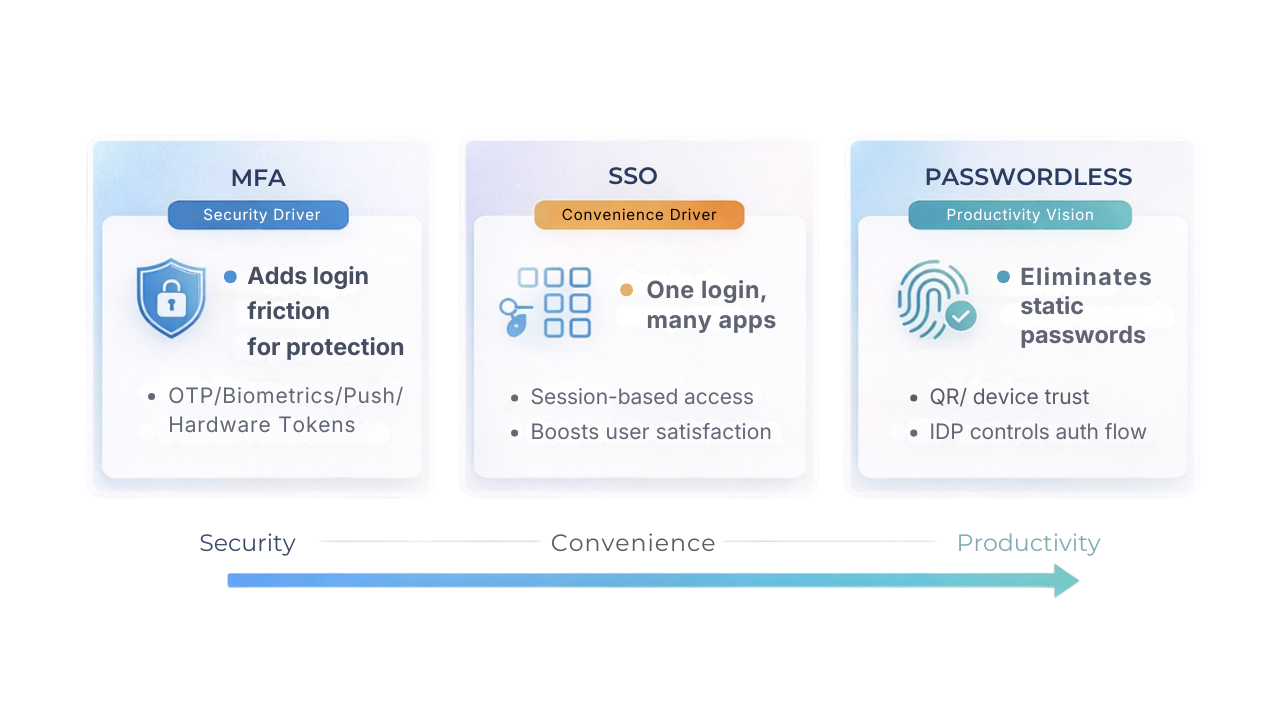
Leadership must distinguish between the three pillars of IAM to align technology with business goals:
- MFA (Security Driver): Driven by security mandates rather than convenience, MFA adds necessary friction to the login process by requiring a second factor like an OTP, biometric scan, or push notification. It is essential for protecting sensitive systems like HR and finance.
- SSO (Convenience Driver): SSO is the primary driver for user satisfaction. By authenticating once to an IDP, a session cookie is set in the browser, allowing the user to access all integrated applications without re-typing their credentials.
- Passwordless (The Productivity Vision): This eliminates static passwords entirely, replacing them with dynamic verification like QR codes or device-based trust. Passwordless is only natively possible when the IDP, not the legacy app, controls the authentication flow.
The Accops Roadmap: Bridging the Gap
At Accops, we recognise that you cannot simply turn off legacy apps. Our ZTNA framework is designed to bridge these two worlds by providing MFA gateways that sit in front of applications you cannot modify. These gateways allow users to perform strong authentication first, effectively securing the entry point.
Looking ahead, we are actively developing advanced Credential Orchestration capabilities. Through a secure, browser-integrated identity handler, the Accops solution intelligently bridges the gap by securely providing the necessary authentication tokens to legacy apps once a user has successfully verified their identity via a passwordless login at the gateway. This mechanism ensures the highest standard of IAM: the security of MFA, the convenience of SSO, and the friction-free experience of Passwordless, even for older, local database-based software.
Building Your Strategic Implementation Plan
Success requires a phased approach rather than a “big bang” rollout:
- Phase 1 (Discovery): Categorise your ecosystem by authentication type and business criticality.
- Phase 2 (Critical Apps): Prioritise your most sensitive legacy apps for MFA to mitigate immediate risks.
- Phase 3 (Modern Apps): Move to modern SAML-ready apps where you can achieve high-value quick wins with SSO.
- Phase 4 (Legacy Gateway): Deploy gateway and automated identity orchestration to eliminate the remaining password prompts across your organisation.
Take the Next Step in Your Identity Transformation
Modernising your IAM framework is a journey of discovery and strategic phasing. For more information on how to audit your current application ecosystem or to take this discussion further with our experts, please reach out to us at contact@accops.com.