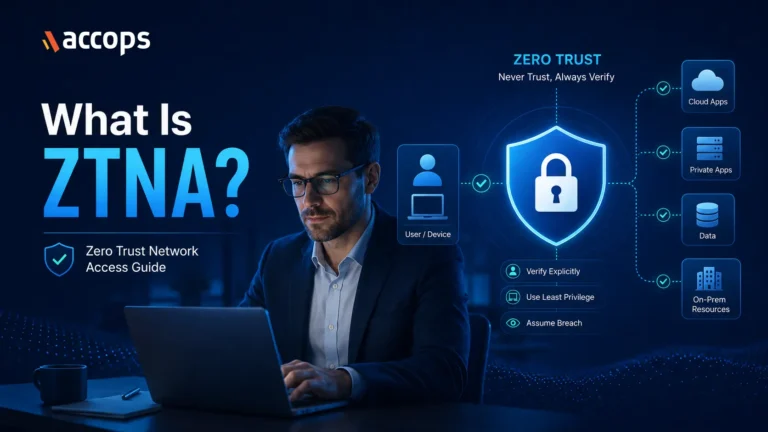
A single stolen VPN credential can still hand an attacker your entire network. That’s the specific failure ZTNA was built to close: instead of a login opening a network segment, it opens exactly one application, for exactly one verified user and device, and nothing else. Zero Trust Network Access checks identity, device posture, and context before every connection, which is why it’s steadily replacing VPN as the default remote-access model rather than sitting beside it as an add-on.
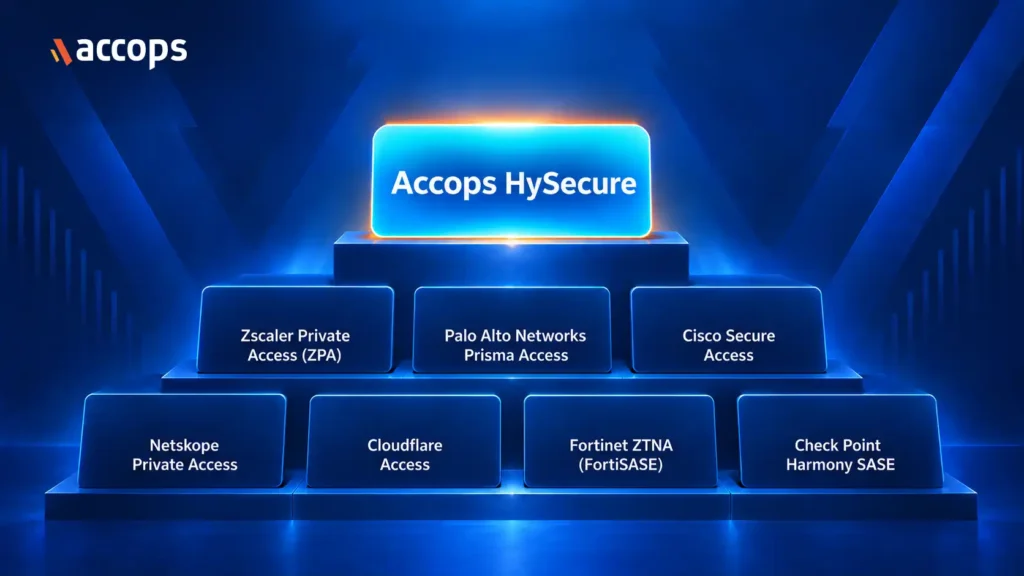
Top 8 Zero Trust Network Access (ZTNA) Solutions in 2026
1. Accops HySecure
Accops HySecure is a ZTNA-based application access gateway built around Secure Private Application Network (SPAN) technology, which creates isolated, encrypted, per-application tunnels rather than one broad network tunnel, covering web apps, client-server systems, RDP and SSH sessions, legacy applications, and virtual desktops. It runs on-premises, in the cloud, or in hybrid mode, using a Reverse Connect architecture that keeps backend server IPs hidden behind a single whitelisted public IP.
The platform includes web application protection (bot management, API and WebSocket protection, and tamper-proofing mapped to the OWASP Top 10 and SANS 25), continuous device posture checks, built-in MFA and SSO, and data-copy controls such as read-only sessions and print-screen blocking, with native integration into Accops’ own VDI platform for organisations that need both.
Accops has also integrated with Forcepoint’s Security Service Edge stack, extending the same session with Forcepoint’s Secure Web Gateway, CASB, DLP, and DSPM. Private application traffic still routes through HySecure ZTNA, while internet access, SaaS usage, and sensitive-data movement are governed by Forcepoint, with both agents orchestrated from the same Accops workspace client.

2. Zscaler Private Access (ZPA)
ZPA is the ZTNA component of the Zscaler Zero Trust Exchange. It brokers direct, one-to-one connections between an authorised user and a specific private app; the user is never placed on the corporate network and the app is never exposed to the public internet. Connectivity runs through App Connectors deployed near the application and Service Edges that can be hosted by Zscaler or run on-premises.
ZPA includes user-to-app segmentation, automated discovery and cataloguing of an organisation’s private application estate, inline inspection for OWASP Top 10 and emerging zero-day risks, and a separate privileged remote access mode for administrators connecting to internal systems.
3. Palo Alto Networks Prisma Access
Prisma Access delivers ZTNA as one component of its Security Service Edge platform, alongside firewall-as-a-service, secure web gateway, and CASB. Its ZTNA Connector automates tunnel setup to private applications, wherever they sit, without requiring manual IPSec or routing configuration, and scales to 2 Gbps per connector.
Access decisions run on a deny-by-default policy engine built on Palo Alto’s User-ID, App-ID, and Device-ID constructs. The platform also layers in Advanced Threat Prevention, Advanced URL Filtering, Enterprise DLP, and WildFire malware analysis, and is managed centrally through Strata Cloud Manager alongside the vendor’s next-generation firewalls.
4. Cisco Secure Access
Cisco Secure Access is a cloud-delivered SSE platform combining ZTNA, secure web gateway, CASB, and firewall-as-a-service under one licence and console. A single unified client authenticates a user and then routes their traffic through ZTNA or VPN-as-a-Service depending on how far that particular application’s migration has progressed, which lets organisations shift off VPN gradually rather than all at once.
The platform includes DLP, remote browser isolation, digital experience monitoring, and Cisco Identity Intelligence, which correlates identity signals from Microsoft Entra ID and other providers.
5. Netskope Private Access
Netskope markets its ZTNA capability as Universal ZTNA, extending the model beyond remote access to cover branch offices and on-premises LANs, positioning it partly as a replacement for traditional network access control.
It supports both agent-based access for managed devices and clientless, browser-based access for BYOD and third-party users. A Local Broker option extends ZTNA into on-premises and OT environments without hairpinning traffic through the cloud, and includes built-in failover routing.
6. Cloudflare Access
Cloudflare Access is the ZTNA product inside the broader Cloudflare One SASE platform, running on Cloudflare’s global Anycast network. It provides identity-first access to self-hosted apps, SaaS, and infrastructure, including browser-based SSH and RDP, without exposing a public IP, using Cloudflare Tunnel for outbound-only connectivity from the resource side.
It integrates with any SAML or OIDC identity provider and supports userless authentication via service tokens for automated systems and APIs. It also extends the same zero trust policies to internal AI tool usage. Cloudflare positions Access as something teams can adopt incrementally, offloading specific apps or higher-risk users from an existing VPN first.
7. Fortinet ZTNA (FortiSASE)
Fortinet delivers ZTNA as part of FortiSASE, its cloud-delivered SASE platform. The FortiClient agent handles ZTNA tagging, SASE traffic redirection, and endpoint protection through a single agent rather than separate tools.
A FortiGate deployed at the organisation’s data centre acts as the ZTNA application gateway, functioning as a reverse proxy that verifies client certificates before granting access, and supports both agent-based and gateway-based deployment models with SD-WAN integration for shortest-path routing. FortiSASE also bundles next-generation dual-mode CASB, DLP backed by FortiGuard AI threat feeds, and browser isolation for selected site categories.
8. Check Point Harmony SASE
Harmony SASE, built partly on Check Point’s acquisition of Perimeter 81, combines ZTNA, firewall-as-a-service, and secure web gateway in one cloud-delivered platform under the Check Point Infinity umbrella.
Its ZTNA model uses full-mesh connectivity that verifies every user and device before granting access to a specific application, rather than the underlying network. Delivery runs through a global network of multiple points of presence, managed from a single console designed for fast deployment without heavy in-house networking expertise. Harmony SASE also integrates with Check Point’s ThreatCloud threat-intelligence and prevention ecosystem for inline threat protection.
Choosing between them
These eight platforms solve the same problem, replacing implicit network trust with per-application verification, but the delivery model differs. Cisco, Palo Alto, Netskope, Fortinet, and Check Point ship ZTNA as one module inside a larger SSE or SASE suite.
Zscaler and Cloudflare are cloud-native platforms built around a global edge network. Accops HySecure runs on-premises or hybrid, with web application protection and identity built directly into the gateway. The right fit depends on how much of your application estate is legacy or on-premises, any data-residency constraints, and whether you’re buying a ZTNA solution standalone or as part of a broader SASE rollout.
Frequently Asked Questions
ZTNA verifies identity, device posture, and context before connecting a user to one specific application, never the network. It replaces implicit trust and blocks lateral movement, which is why it's replacing VPNs as the default remote access model.
A VPN places a user on the corporate network, exposing everything reachable from that segment. ZTNA connects a user only to one authorised application, keeping the rest of the network invisible and reducing the impact of a stolen credential.
It depends on the application estate. Legacy, thick-client, or highly sensitive apps often still suit VDI delivery, while web and client-server apps move cleanly to ZTNA. Several vendors, including Accops, run both under one platform.